The Brain Break That Doesn't Wind Them Up
A tracing video gives a restless class a way to reset without the chaos. Here's why it works, and how to use one well.
You already know which brain breaks backfire. The dance-along that was supposed to run two minutes and somehow ends with half the room on the floor. The energizer that energized a little too well, and now you've spent longer pulling everyone back than the break ever saved you.
Teachers ask the same thing about every brain break: will my class actually be able to refocus afterward? It's the high-energy rooms that make you cautious, the ones that have a hard time coming back down once they're up.
Tracing videos are the rare brain break that brings them down instead.
What a tracing video actually is
A tracing video is a short, music-paced brain break where students follow a line or shape as it moves across the screen, tracing along with a finger or their eyes. The shape maps to the song. As the music rises and dips, the line follows. Students might trace in the air, on their desks, or on blank paper. When the song ends, so does the break.
That's the whole thing. You press play, and the class gets quiet.
Why it settles a room
Give a wound-up brain one simple thing to follow, and it tends to calm down. A moving line is about as simple as a focal point gets. Nothing to win, no partner to poke. Just a shape to keep up with.
The tracing itself is important too. Restless hands get something small to do, which is often what a fidgety student actually needs after recess. It's movement, but the quiet kind. The body stays in its seat while the attention narrows to one task.
And then there's the music. This is the part Mood Magic was built around. Predictable, calming sound gives the nervous system a steadier signal than a pop song or a hype track ever could. The research behind our videos points in the same direction: when the sound is calm and predictable, kids settle faster and stay settled longer. A tracing video stacks that calming audio on top of a single visual anchor, which is why it tends to bring the temperature of a room down rather than up.
The song length does one more quiet favor. It's a built-in timer. The break has an obvious finish line, so there's no negotiating "one more minute." The music ends, and everyone already knows what comes next.
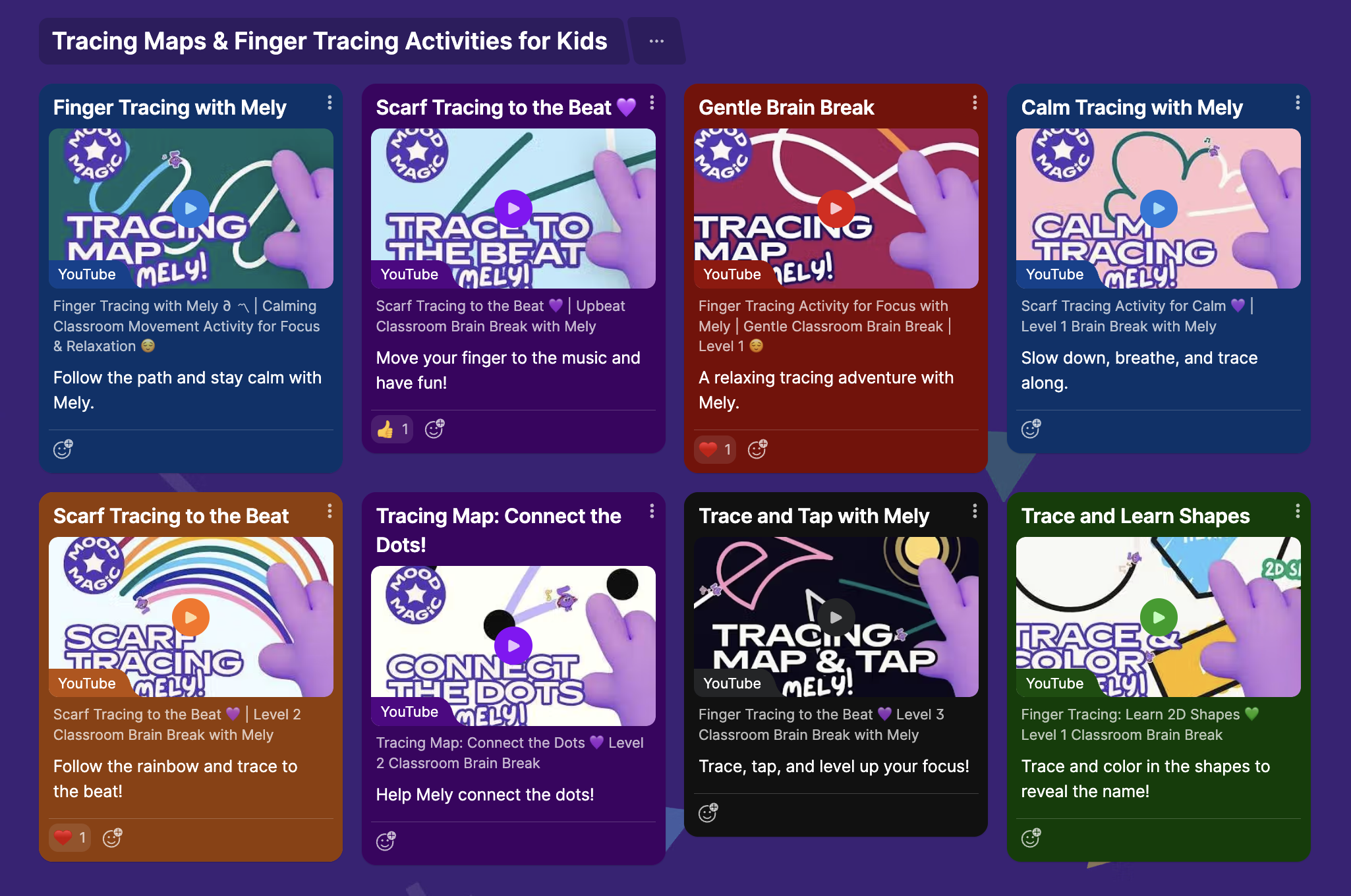
Mood Magic's "Tracing Map Playlist" on Padlet — eight finger-tracing and classroom brain break videos for kids, from Connect the Dots to Trace and Learn Shapes, all hosted by mascot Mely. Tap to open the full playlist.
Where it fits in the day
Tracing videos earn their keep in the in-between moments:
The reset after recess or lunch, when bodies are still buzzing
The minute before a test or a long writing block, to bring focus down to a point
The handoff between two subjects, when attention tends to scatter
Morning arrival, as students trickle in and need somewhere to put their eyes
The calm-down corner, for one student who needs a moment on their own
You don't need a reason beyond "the room feels loud." That's reason enough.
Small moves that make tracing videos work
Keep it to a single song. That's enough to reset the room.
Model it the first few times. Hold your own finger up and trace along so students can see what calm participation looks like. In our videos, Mely does this for you, tracing right alongside the class without a word of instruction, so even your youngest students can copy without being told.
Pick a surface and name it. "Trace in the air today" or "use your desk" keeps thirty kids from each inventing their own version.
Then do it the same way, in the same moments, again and again. It works because it's the same every time. When it shows up at the same point every day, students stop treating it as a break to get rowdy about and start treating it as the cue to settle. It becomes part of the rhythm of your room.
Try one tomorrow
If you want a set that's ready to go, we keep our tracing videos in one place so you're not hunting for them mid-transition. They're built on the same calm, predictable sound as the rest of Mood Magic, with Mely there to model the way.
Press play after recess tomorrow and watch what the room does. You'll feel the shift before the first song is over.